









BFCM Strategy: Why Your Best Offers Kill LTV | Lifetimely
Hot take: your best-performing BFCM offer on Day 1 may be the worst-performing offer by Day 90.
Most subscription brands choose their BFCM and holiday offers based on front-end economics — conversion rate, nCAC, and the sheer scalability of Q4 acquisition numbers. That makes sense on the surface. But it misses a critical detail.
Aggressive discounts and highly scalable front-end offers often attract lower-commitment subscribers who ruin long-term LTV and actual profit. In certain scenarios you spend $1 to get back $0.8. Disaster.
The cautionary tale every subscription brand needs to hear
This is a real story from a 9-figure client of mine, documented in my book Retention Economics.
The client ran an extremely successful acquisition campaign built around a seasonal freebie. The media buyers went nuts. The CMO asked to make it sitewide and repeat the offer the following month. Everyone was thrilled — founder, CMO, customer service agents, the lot.
Then the retention data came in.
The latest cohort’s retention had dropped significantly. The new buyers wanted the seasonal freebie more than the core product they were being re-billed for. The acquisition team killed the offer immediately. It was a disaster.
The lesson: acquisition is instant. Retention needs 60 to 90 days to properly report. Keep both in mind whenever you’re scaling an offer that appears to “print.”
If you’re building a business on strong retention and LTV, you don’t want to buy tens of thousands of the wrong customers who’ll never return — and never let you break even.
Catch a bad BFCM cohort before day 90.
Lifetimely tracks repeat rate, LTV and payback for every cohort.
Start free trial →The right framework: one offer isn’t the answer
The question isn’t “what’s the perfect BFCM offer?” It’s “what’s the right offer for the right customer?” That shift in framing changes everything.
BFCM offers for existing customers
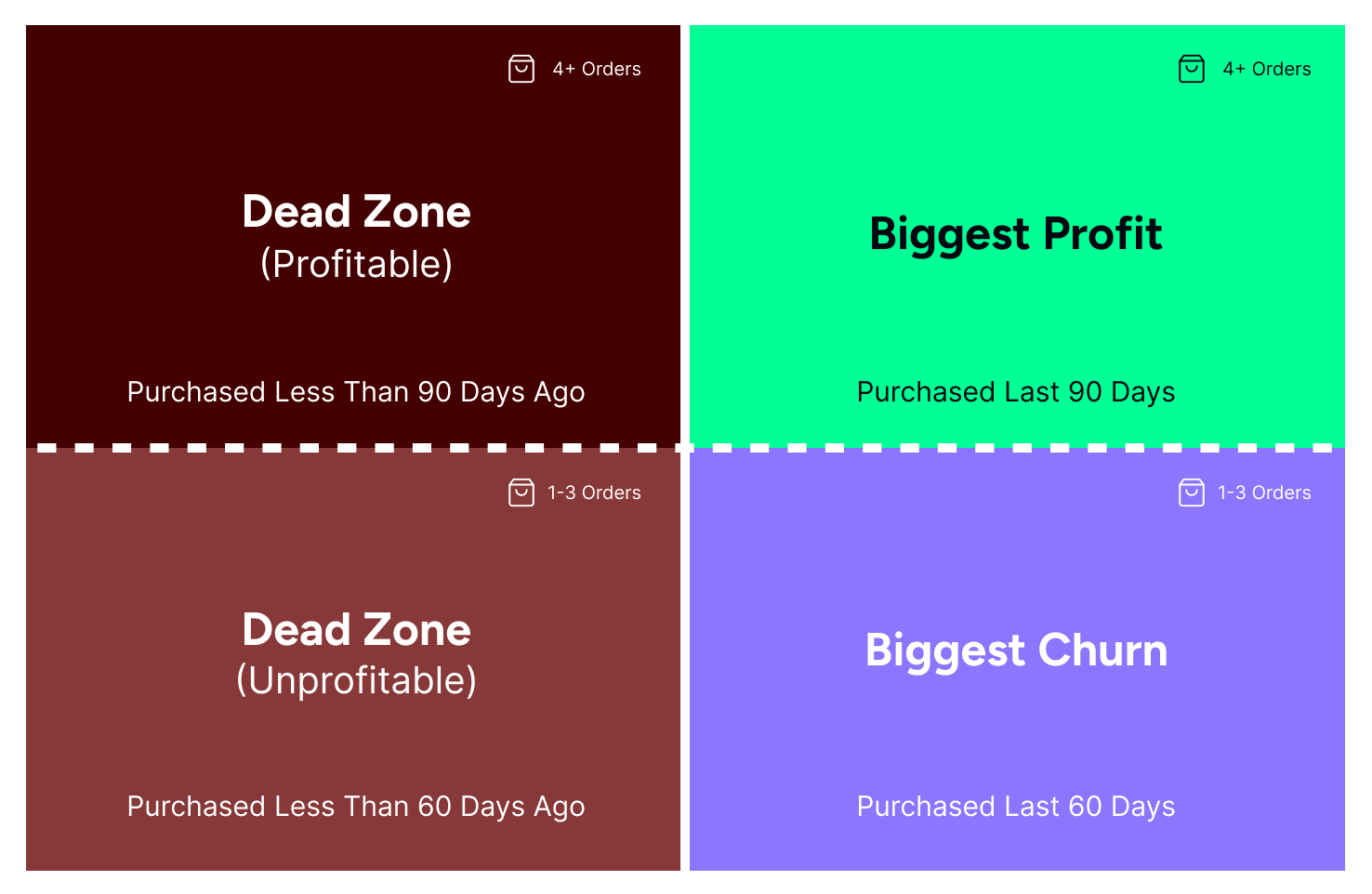
Open the RFM breakdown of your customer base and identify four quadrants:
| Quadrant | Definition |
|---|---|
| Biggest Churn | 1–3 orders, purchased in the last 60 days |
| Biggest Profit | 4+ orders, purchased in the last 90 days |
| Dead Yet Profitable | 4+ orders, last purchase 90+ days ago |
| Dead & Unprofitable | 1–3 orders, last purchase 60+ days ago |
Each quadrant has a specific objective:
| Quadrant | Objective |
|---|---|
| Biggest Churn | Get them to Order 4 and start profiting |
| Biggest Profit | Lock them into 3-, 6-, or 12-month subscriptions |
| Dead Yet Profitable | Reactivate with a small profit margin plus a 3-month commitment |
| Dead & Unprofitable | Reactivate at break-even plus a subscription |
This breakdown and the exact offer mechanics can get nuanced, but this is always the starting point.
BFCM offers for new acquisition
Existing customers can be segmented by known behaviour. New buyers have no purchase history, so the acquisition offer itself has to do the filtering — it needs to attract committed buyers, not freebie hunters.
As a rule of thumb: keep the same welcome discount percentage you’d normally offer, but significantly increase the perceived value.
High-converting acquisition offer types:
- Premium physical freebie with the first order — evergreen, genuinely complementary to the core product. Not a seasonal item.
- Collaboration with a complementary app or brand — 3 to 6 months free. A powerful way to increase the total value of the offer without margin damage.
- Digital guide or video masterclass — guides are quicker to produce; a masterclass takes more time but converts on credibility.
- Future freebies — e.g. “$200 worth of freebies over your first year.” Creates forward-looking commitment.
- Giveaway entry — ensure the terms comply with applicable state laws.
- Random refunds to 50 orders — same legal note. Film the founder or a team member calling the winners and build a campaign around it.
These offers increase perceived value and engineer intent while preserving margin. The customers they attract want the brand, not just the deal.
Structuring the post-checkout upsell
- One option only at checkout. Offer a 30-day subscription to reduce friction and secure the lowest CAC possible.
- Immediately after checkout, upsell more volume. If the product supports 2–3 servings per day, offer 60 or 90 servings at a discount on the same 30-day billing cycle.
- If volume upsell doesn’t fit, upsell commitment instead. Immediately offer a quarterly subscription. Payment at the end of the 30-day cycle converts far better than upfront payment. Reward the commitment with extra freebies.
Three more 7-figure BFCM tips
Run BFCM for the whole of November, not just one week. Four to five weeks of BFCM-adjacent offers outperforms the compressed seven-day sprint most brands default to.
Design 8 to 10 offer variations, not one. Run one or two per week. Kill offers that don’t convert. Extend offers that scale. Keep deadlines short — seven days maximum per offer. Customers stay engaged; urgency stays real.
Launch a BFCM-style promotion in May. Six months after BFCM, with less competition, lower CAC, and often more revenue than the actual event. Position it as the brand founder’s birthday, claim a product category celebration (“Mushroom Coffee Month,” “GLP-1 Awareness Month”), or any other defensible reason to celebrate. Own the moment.
The brands I’ve worked with that apply these approaches consistently turn BFCM into something more than their biggest acquisition event. They make it the most profitable customer cohort they acquire all year.
Which BFCM offers bought customers, and which bought churn?
Connect Shopify and see how last year's BFCM cohorts really performed.
Start free trial →
Thomas Lalas
Thomas Lalas is a retention strategist for 8- and 9-figure ecommerce brands and the creator of The Vitruvian, a retention supersystem proven to increase 30-day repurchase rates, LTV, and subscription revenue. His Lifetimely-endorsed book Retention Economics reveals the principles behind sustainable ecommerce growth.