









Ecommerce Reviews: What They're Worth Beyond | Lifetimely
Written by
 Nuno Brito Growth Lead at Lifetimely
Ecommerce reviews are ratings and written feedback left by customers on a product page, collected and displayed by a review app such as Okendo, Judge.me or Yotpo. They exist to help a stranger decide whether to buy something they cannot touch.
That is the job everyone knows about, and most brands run their review programme entirely against it: collect more reviews, keep the average above 4.5, show the star rating on the product page and in Google. Fine as far as it goes.
The part almost nobody does is work out what a review is worth after the sale. A five-star rating is a signal from a customer who just had a good experience. Whether that customer comes back, how often, and at what margin, is a different question with a different answer. Sometimes your best-rated product is your worst repeat driver. Sometimes the customers who bother to leave a review are worth twice the ones who don’t, and nobody has ever checked.
This guide covers how ecommerce reviews work, what the evidence actually supports, how to collect more of them, how to read the numbers without kidding yourself, and how to connect review data to the metrics that decide whether a customer was worth acquiring.
What are ecommerce reviews?
Ecommerce reviews are customer-submitted ratings and feedback attached to a specific product, usually a one to five star rating plus optional text, photos or video. On Shopify they are collected and rendered by a dedicated review app rather than by the platform itself.
A few distinctions worth keeping straight, because they change how you read the data:
- Product reviews vs site reviews. A product review is about one item. A site review, the kind you see on Trustpilot or Google, is about the brand and the buying experience. Both are useful. Only the first one can be tied to a SKU and a margin.
- Verified vs unverified. A verified buyer review comes from someone the app can match to a real order. Unverified reviews can come from anyone. Most review apps label the difference, and shoppers notice it.
- Reviews vs UGC. Photos and videos submitted alongside a review are user generated content. They behave differently from text: PowerReviews measured a 163.6% lift in conversion among shoppers who interact with a customer photo or video on a product page.
- Reviews vs survey answers. A post-purchase survey asks a question you wrote. A review answers a question you didn’t ask. The two are complementary, and both are tied to an order, which is what makes either of them measurable later.
Why ecommerce reviews matter, and what the numbers actually say
Almost everyone reads them. In a June 2025 survey of 21,279 US consumers, PowerReviews found 95% regularly read product reviews as part of their shopping journey, and only 43% would buy a product with zero ratings or reviews.
The jump from none to some is the big one. Analysing 4.5 billion visits across 1.55 million product pages on 1,200 sites, PowerReviews recorded a 76.7% conversion lift for shoppers exposed to at least one review versus none. Northwestern’s Spiegel Research Center, working with PowerReviews data, put purchase likelihood for a product with five reviews at 270% above a product with none. Treat the exact figures as directional. The pattern, that the first handful of reviews does most of the work, holds across both.
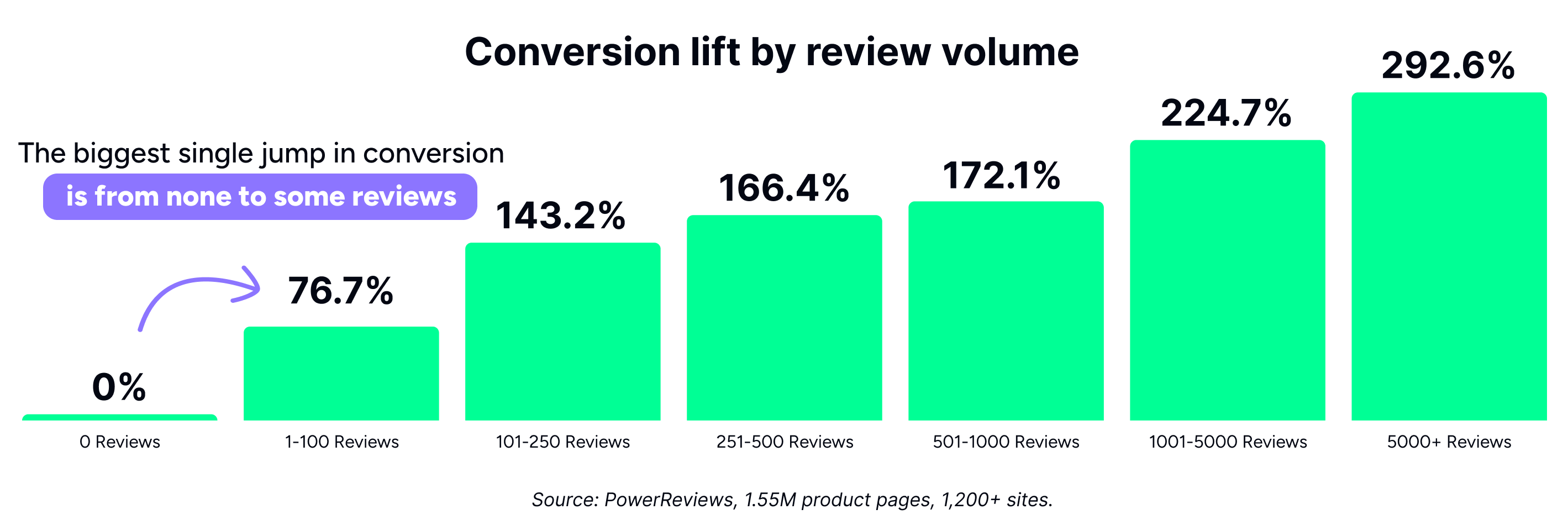
More reviews keep helping, with diminishing returns. The same PowerReviews analysis found conversion lift rising with volume: 143.2% at 101 to 250 reviews, 172.1% at 501 to 1,000, and 292.6% at 5,000 or more, all measured against zero. Most Shopify brands will never see five figures of reviews on a SKU, which is fine. The useful read is that going from 3 reviews to 30 matters more than going from 300 to 3,000.
| Review volume | Conversion lift vs zero reviews |
|---|---|
| 1–100 | +76.7% |
| 101–250 | +143.2% |
| 251–500 | +166.4% |
| 501–1,000 | +172.1% |
| 1,001–5,000 | +224.7% |
| 5,000+ | +292.6% |
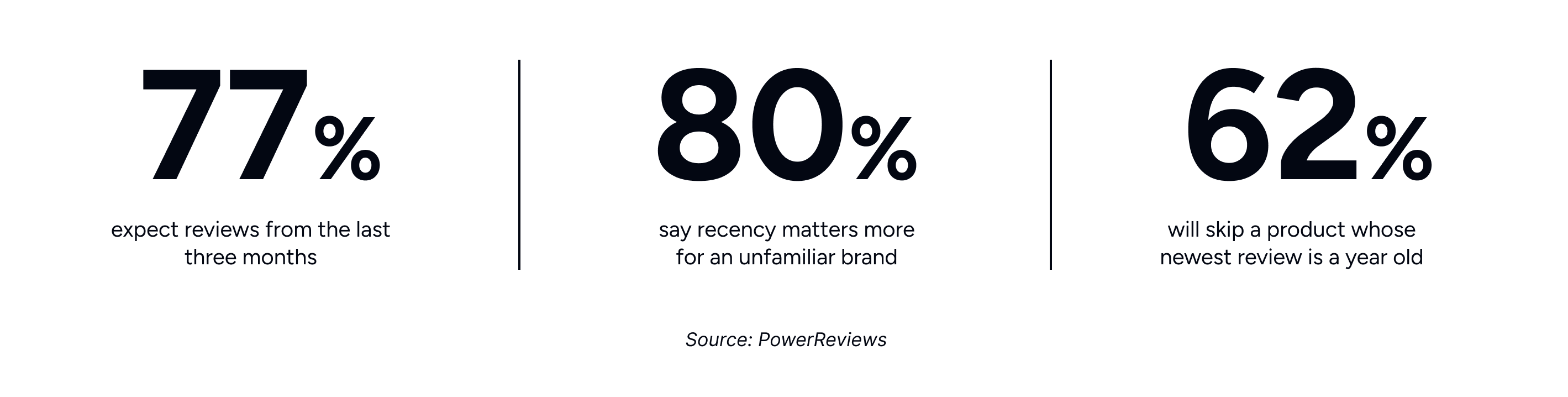
Reviews go stale. This is the finding most brands underrate. In PowerReviews’ 2025 research, 77% of consumers expect reviews to have been left within the past three months, and 80% say recency matters more when they are considering a brand they have not bought before. An earlier study in the same series found 62% would skip a product entirely if the only reviews available were a year or more old. A product page with 400 reviews, all from 2023, is closer to a page with no reviews than the count suggests.
Price and novelty raise the stakes. Consumers say they weigh review volume most heavily on high price point or luxury items (73%) and on new arrivals (67%). Those are usually the products carrying your best margin and your biggest launch budget.
There is also a search argument. Review apps output structured data (the AggregateRating and Review schema types) which makes star ratings eligible to appear in Google results, and increasingly gives answer engines something concrete to cite when someone asks whether a product is any good. That is a genuine benefit. It is also a reason to keep review content fresh rather than let a product page coast on old ratings.
How review apps work on Shopify
Every review app on Shopify does five jobs. The differences between them are mostly about how far each one goes, and how much of the rest of your retention stack it tries to own.

- Collection. The app sends a review request after delivery, usually by email, sometimes by SMS or an on-site prompt. Timing is configurable and matters. It also decides what to ask for: a star rating alone, or rating plus text, photos, video, and attribute ratings such as fit, scent or skin type.
- Display. Widgets on the product page, a reviews carousel on the homepage, star ratings on collection pages, and the structured data that feeds Google. Page weight varies a lot between apps, which is worth checking against your Core Web Vitals.
- Moderation. Filtering spam, handling profanity, publishing responses to negative reviews. Suppressing or reordering reviews to hide criticism is a bad idea both commercially and legally, and shoppers are good at spotting a suspiciously clean review wall.
- Syndication and distribution. Pushing reviews to Google Shopping, to retail partners, or to a social channel.
- Data out. Every review carries a product, a star rating, a timestamp, and, for verified reviews, a customer. That last field is the one this article is really about, and it is the one most brands never use.
Okendo, Judge.me and Yotpo
The three most common choices on Shopify, described by what they are built for rather than ranked:
- Judge.me is the most widely installed reviews app on Shopify, largely because the free tier is genuinely usable and the widget is light. It is the straightforward choice for brands that want high review volume without adding another platform to manage.
- Okendo is built around customer intelligence as much as reviews: attribute ratings, surveys, quizzes, referrals and loyalty, with a deep Klaviyo integration and strong rich snippet output. It suits brands where the review is one input into a wider customer profile.
- Yotpo bundles reviews with SMS, loyalty and subscriptions. It fits brands that want reviews inside a single retention suite rather than as a standalone tool.
Choosing between them is mostly a question of how much of your retention stack you want in one place, and how much review volume you need to justify the cost. All three collect the same fundamental thing: a rating, tied to a product, tied to an order.

How to get more ecommerce reviews
Review coverage, meaning the share of your catalogue with a useful number of recent reviews, is the metric to manage. Most brands have a handful of hero products carrying hundreds of reviews and a long tail sitting at zero, which is exactly backwards if some of that tail is high margin.
- Ask twice. PowerReviews found roughly a third of shoppers (32%) need to be asked more than once before they submit a review, and that up to 80% of reviews originate from post-purchase emails. A single request leaves most of the available volume on the table.
- Time the ask to the product. The customer needs to have used the thing. Rough guide from PowerReviews’ own benchmarks: seasonal goods within 7 days, perishables and soft goods within 14, durable hard goods around 21. A supplement that takes a month to show results should not be asking on day three.
- Make the first click the whole ask. A star rating embedded in the review request email, with the text box appearing after, converts far better than a link to a form.
- Ask for photos, and make it easy. Visual content carries disproportionate conversion weight and it is the part shoppers trust most.
- Prioritise by commercial value, not by traffic. This is where most review programmes go wrong. The default is to chase reviews for whatever sells most. The better target is products with strong margin or strong repeat behavior and thin review coverage, because those are the pages where a handful of new reviews changes the most.
- Launch new products with reviews already in place. Sampling, a pre-launch list, or a subscriber send. 80% of consumers say recency matters more for a brand or product they have not bought before, and a new SKU is the definition of that.
- Keep the stream running. Review recency is not a project you finish. A quarterly audit of which products have gone quiet beats a one-off collection push.
Want to know which products deserve your next review request?
Connect your review app to Lifetimely and see ratings next to repeat rate, margin and LTV.
Start free trialHow to read ecommerce review data without fooling yourself
Review dashboards produce confident-looking averages. A few habits keep them honest.
- The average rating hides the distribution. A 4.5 made of mostly fives and a few ones is a different product from a 4.5 made of fours. The first has a segment of genuinely unhappy customers who will not come back. The second has a product that is fine and nobody loves.
- Who reviews is not who buys. Reviewers are self-selected, skewed towards strong feelings in either direction and towards people who open post-purchase email. Their opinions are real. Their proportions are not representative.
- Review volume follows traffic, not quality. Your most reviewed product is usually just your most sold product. Ranking the catalogue by review count tells you about merchandising history, not about what customers value.
- Small samples lie. A product with seven reviews and a 4.9 average has not earned that rating. Set a minimum count before you act on any comparison.
- Sentiment is not commercial performance. A product can be loved and still be a bad thing to sell: thin margin, high return rate, or a first purchase that never leads to a second. Nothing in a review app will tell you that, because the review app cannot see your costs.
That last point is the gap. Your review app knows what customers said. It does not know what those customers were worth.
What a review is worth: connecting ratings to LTV and margin
Every verified review carries a customer ID. Your store knows what that customer did next: every reorder, every discount, every refund, alongside what the product costs you and what you paid to acquire them. Join the two and you can answer questions neither dataset can answer alone:
- Do customers who leave a five-star review repurchase more often than customers who leave none, and by how much?
- Which products have the strongest ratings and the weakest contribution margin?
- Which high-LTV products have almost no review coverage?
- Do highly rated products produce customers who come back, or customers who buy once and leave happy?
- Which poorly rated products are quietly driving your refund rate?
This is the layer Lifetimely adds. Connect Okendo, Judge.me or Yotpo and every product in your reporting carries its average rating, total review count and verified review count next to revenue, margin, refunds, repeat rate and cohort LTV. Repeat purchase behavior can be broken down by star rating directly, so “do happy customers come back” stops being a hypothesis.
Three things brands look at first
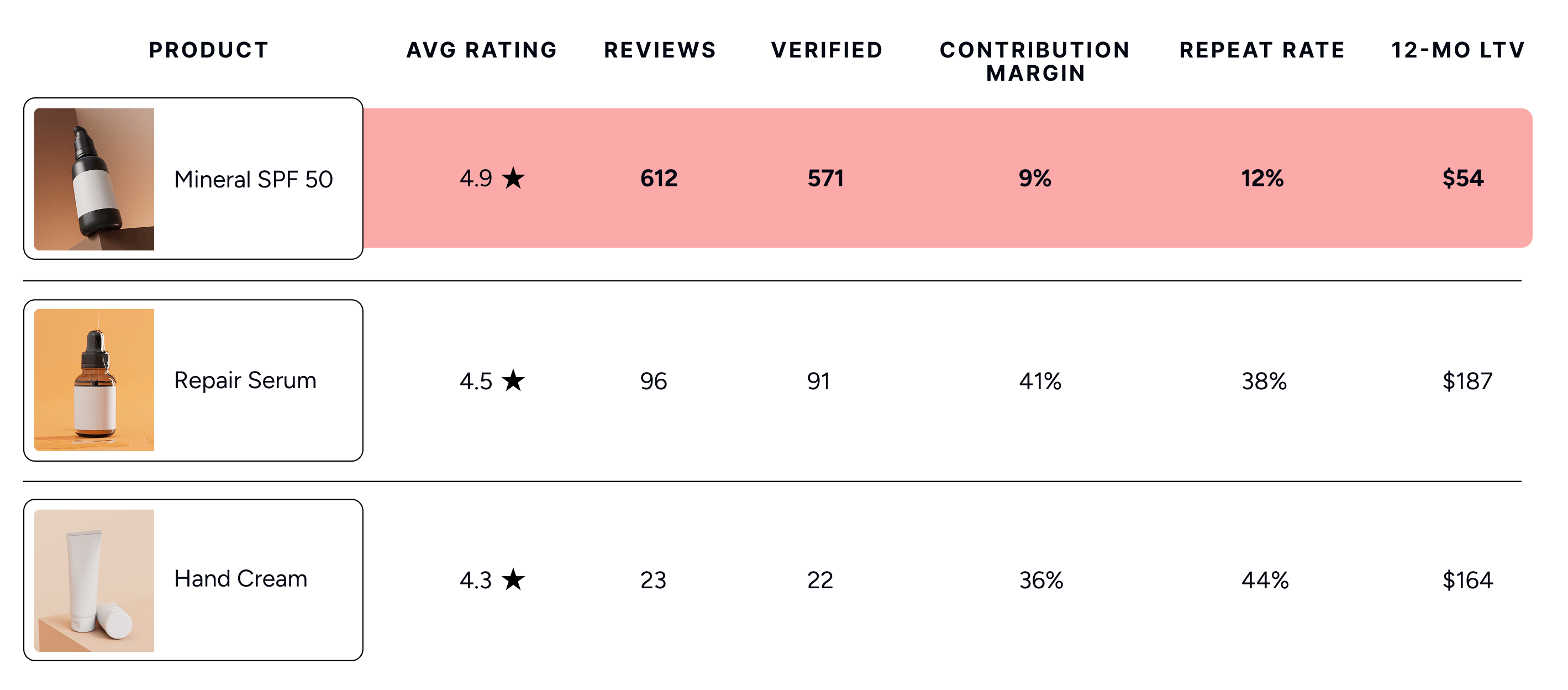
1. Best rated, weakest contribution margin. Sort the catalogue by average rating, then look at contribution margin and refund rate beside it. The pattern that usually shows up is a well-loved entry product, often a starter kit or discovery set, that customers rate highly and that converts poorly into a second order at an acceptable margin. It is a real problem and it is invisible in both a review dashboard and a revenue report, because each one only sees half of it.
2. Reviewers as a cohort. Split customers by whether they left a review and compare 12-month LTV, repeat rate and time to second order. Reviewers are frequently among the most valuable groups in a store, which makes the ones who have gone quiet past their normal reorder window an obvious audience rather than a guess.
3. Coverage gaps ranked by value. Cross your review count against cohort LTV by product. The output is a short list of products that bring back valuable customers and have almost nothing on the page to convince a new shopper to try them. That list is where the next review request campaign should point.
Asking it in plain language
Instead of exporting review data and cross-referencing it against a margin report by hand, you can describe what you want to know.
Lifetimely’s Profit Agent runs the analysis across your store data and comes back with the finding, the reasoning and a recommended next step. Something along the lines of:
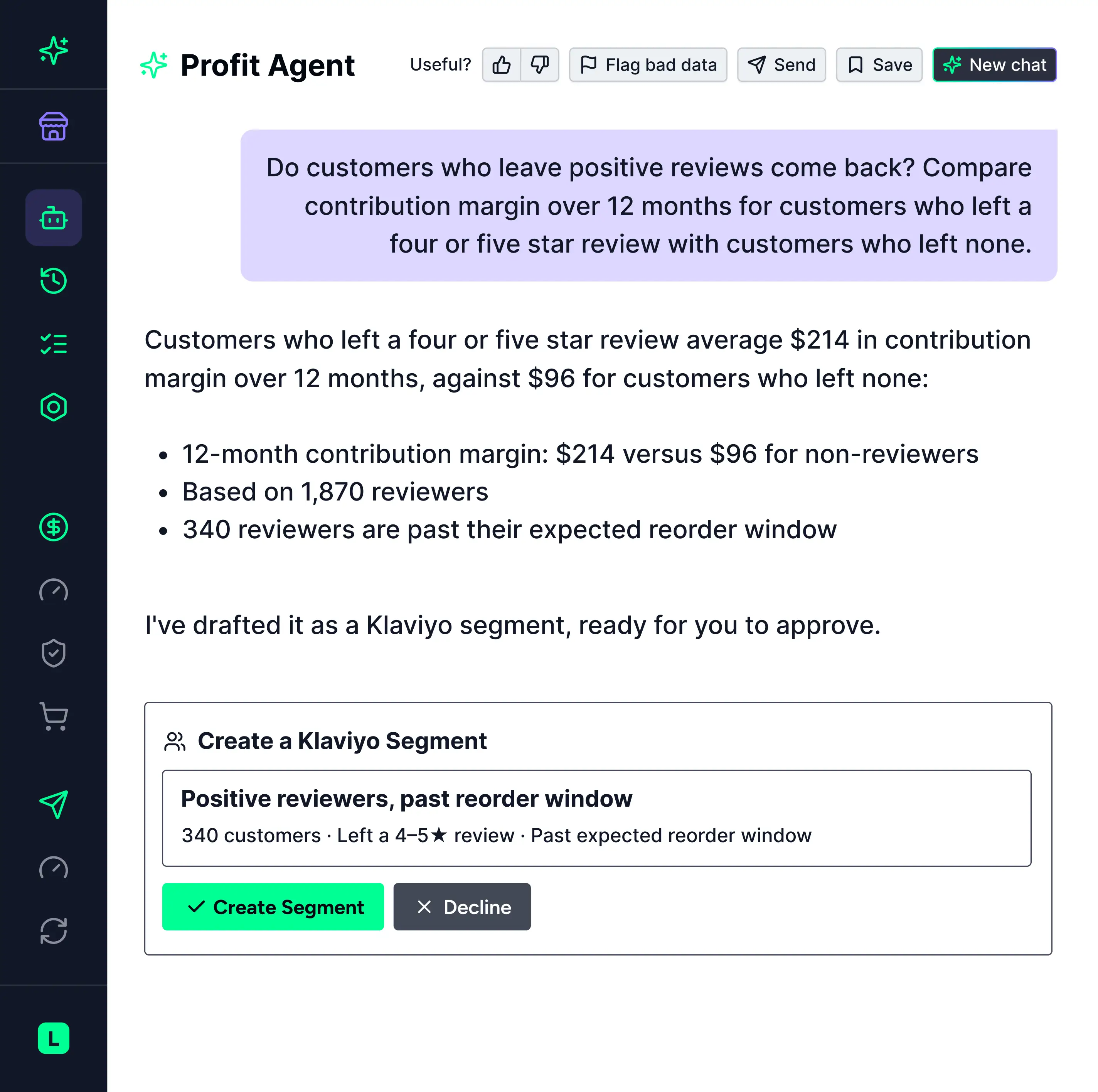
You approve before anything runs, and the results come back so you can see whether it worked.
Already running Okendo, Judge.me or Yotpo?
Connect your reviews to Lifetimely and find out what your five-star customers are actually worth.
Start free trialCommon ecommerce review mistakes
- Chasing the average rating. A 4.9 across a catalogue usually means the review request is going to the wrong people, or the unhappy ones are quietly churning without saying anything. Aim for volume, recency and coverage. The average will look after itself.
- Letting reviews age out. Recency is the thing shoppers check and the thing brands forget. A product page with old reviews reads as a product nobody has bought recently.
- One ask, one channel. A third of customers need a second prompt, and you are leaving most of your potential volume behind without one.
- Treating negative reviews as a PR problem. A cluster of two-star reviews on one SKU is product feedback with a commercial cost attached, and it is usually cheaper to fix than to bury.
- Never connecting reviews to anything. A review programme that only ever feeds a widget is doing one of the two jobs it could do. The data is already tied to an order. Use it.
Ecommerce reviews FAQ
What are ecommerce reviews?
Ecommerce reviews are ratings and written feedback left by customers about a specific product, displayed on the product page and collected by a review app such as Okendo, Judge.me or Yotpo. They typically include a one to five star rating and often photos or video.
Why are product reviews important for ecommerce?
They are the main way a shopper judges a product they cannot handle. Research from PowerReviews found 95% of consumers regularly read reviews and only 43% would buy a product with none, and measured a 76.7% conversion lift for shoppers exposed to at least one review versus none. Reviews also feed structured data that lets star ratings appear in search results.
How do you get more customer reviews?
Send a post-purchase review request timed to when the customer has actually used the product, ask a second time if they do not respond, put the star rating directly in the email so the first click is the whole ask, and invite photos. PowerReviews found up to 80% of reviews come from post-purchase emails and that around 32% of shoppers need more than one ask.
What is a good number of reviews for a product?
There is no universal number, but the biggest gain is at the start. The first handful of reviews produces most of the conversion lift, and returns diminish as volume grows. Getting a product from zero to twenty reviews is worth far more than getting another product from three hundred to a thousand.
How recent do ecommerce reviews need to be?
Recent enough that the newest one is inside the last three months. PowerReviews found 77% of consumers expect reviews within that window, and 80% say recency matters more when they are considering a brand they have not bought before.
What is review coverage?
Review coverage is the share of your catalogue carrying a useful number of recent reviews. It is a more actionable metric than total review count, because it shows you which products have nothing on the page to reassure a new shopper.
Do ecommerce reviews help SEO?
Indirectly, yes. Review apps output AggregateRating and Review structured data, which makes star ratings eligible for rich results in Google and gives answer engines specific, citable content about a product. Fresh review text also keeps product pages from going static.
How do you know which reviews are worth the most?
Join the review to the customer who wrote it, then compare repeat rate, contribution margin and 12-month LTV between reviewers and non-reviewers, and across star ratings. Tools that connect your review app to your customer data, such as Lifetimely, do this without exports.
Collect the reviews, then price them
Ecommerce reviews earn their keep twice. The first time is on the product page, where they do the job everyone already measures. The second time is in your customer data, where they tell you which products create customers worth keeping and which ones are loved by people who never come back.
Most brands only collect the first return. The second one costs nothing extra, because the data is already sitting in two systems that have never been introduced.
Lifetimely connects to Okendo, Judge.me and Yotpo, as well as Shopify and Klaviyo, and starts pricing your review data on LTV and contribution margin as soon as it is in. Built on $100B+ in GMV across 45,000 stores, it already knows what a valuable customer looks like for a brand like yours.
Find out what your five-star customers are worth.
Start free trialSources
- PowerReviews, The Complete Guide to Ratings & Reviews (June 2025 survey, 21,279 consumers)
- PowerReviews, The Power of Review Volume & Recency (9,012 consumers; 4.5B visits across 1.55M product pages on 1,200+ sites)
- Medill Spiegel Research Center, Northwestern University, How Online Reviews Influence Sales
Nuno Brito
Nuno Brito is Growth Lead at Lifetimely, where he writes about profit, retention and the numbers ecommerce brands should actually run on. He has spent over a decade in B2B SaaS marketing, from copywriting to product marketing and GTM at PandaDoc, Talkdesk and TaxCloud, including launching PandaDoc Notary to seven-figure ARR. He has a soft spot for SEO and AEO. When he's off the clock, he's looking for a wave to surf.