









Shopify Subscription Apps: How They Work and | Lifetimely
Written by
 Nuno Brito Growth Lead at Lifetimely
 Works with Skio, Recharge, Stay AI, Loop, Appstle and Seal
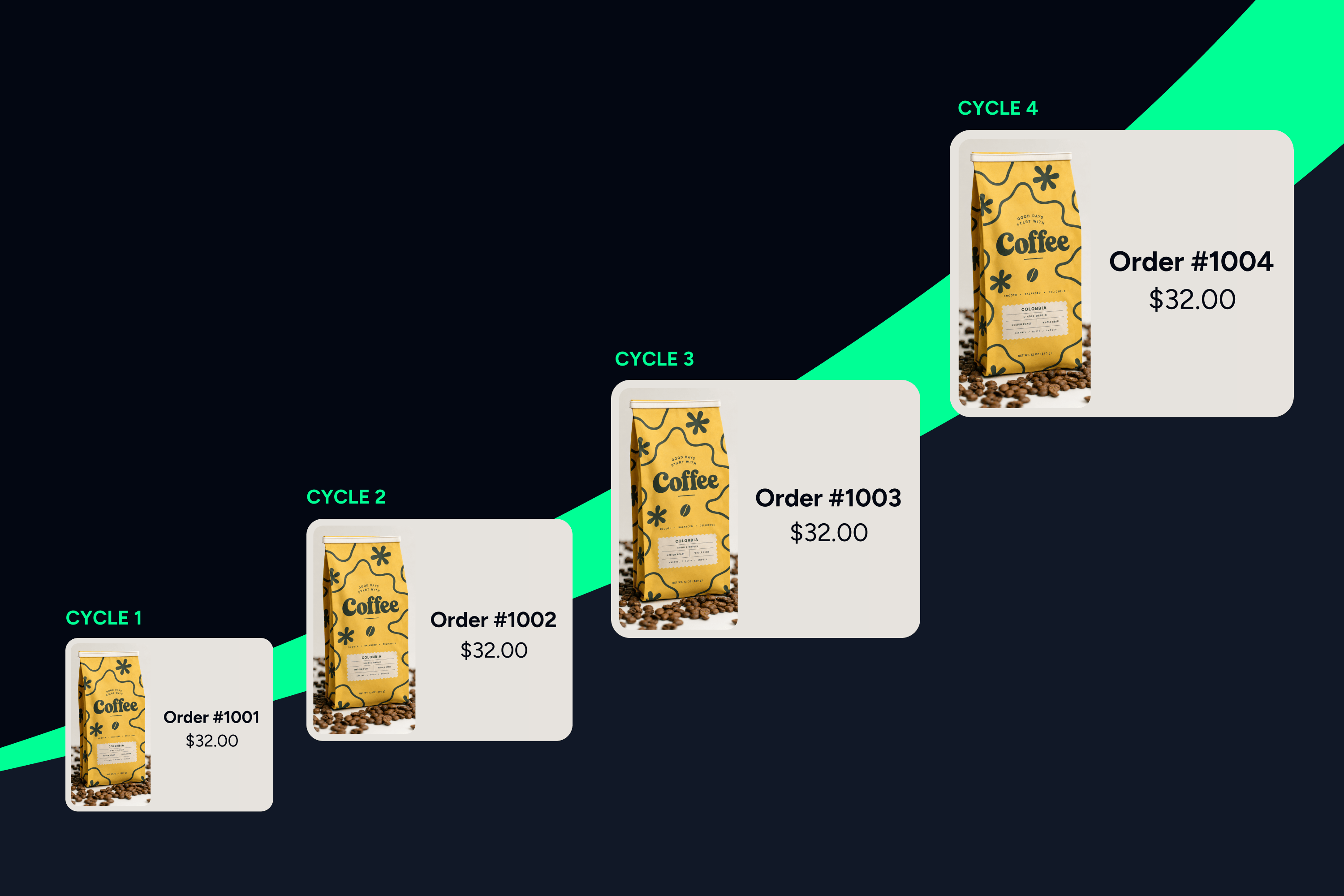
A Shopify subscription app lets a customer buy a product on a repeating schedule: every two weeks, every month, every quarter. It adds the subscribe-and-save option to the product page, charges the saved payment method each cycle, creates a new order in Shopify every time and gives the customer a portal where they can skip, pause, swap or cancel without emailing support.
For a brand selling something people run out of, that one app changes the business. Revenue becomes something you can forecast, and a customer you paid to acquire once keeps paying you back for months. It also creates a new set of problems. Subscribers cancel, cards fail, discounts quietly eat margin, and the subscription app reports on all of it from inside the subscription, with no view of what that customer cost to acquire, what the product cost to ship, or what the same person bought outside the plan.
This guide covers how Shopify subscription apps work, the six apps most brands end up choosing between, how to set one up well, the subscription metrics worth tracking, and the step most brands skip: working out what each subscriber is worth in lifetime value and contribution margin.
What is a Shopify subscription app?
A Shopify subscription app is an app that adds recurring purchase options to a Shopify store. Shopify handles the checkout, the payment vault and the orders. The app handles the products customers can subscribe to, on what schedule and at what discount, then manages everything that happens after the first order: rebilling, the customer portal, failed payment recovery and cancellation.
Shopify ships its own free app, Shopify Subscriptions, which covers the basics: selling plans, a simple customer portal and automatic rebills. Most brands with a serious subscription programme use a dedicated app instead, because the hard part of subscriptions is not taking the first order. It is keeping the subscriber past the second, third and sixth order, and that takes tooling the basic app does not have: cancellation flows with save offers, smarter payment retries, build-a-box, rewards and reporting on churn.
Subscriptions on Shopify come in two main flavours, and most apps support both.
- Subscribe-and-save is the replenishment model: the same product, delivered on a schedule, usually at 10 to 20% off the one-time price.
- Curated or build-a-box subscriptions rotate products each cycle, chosen either by the brand or by the customer in the portal.
Prepaid plans, where the customer pays for three or six months upfront, sit alongside both.
How do Shopify subscription apps work?
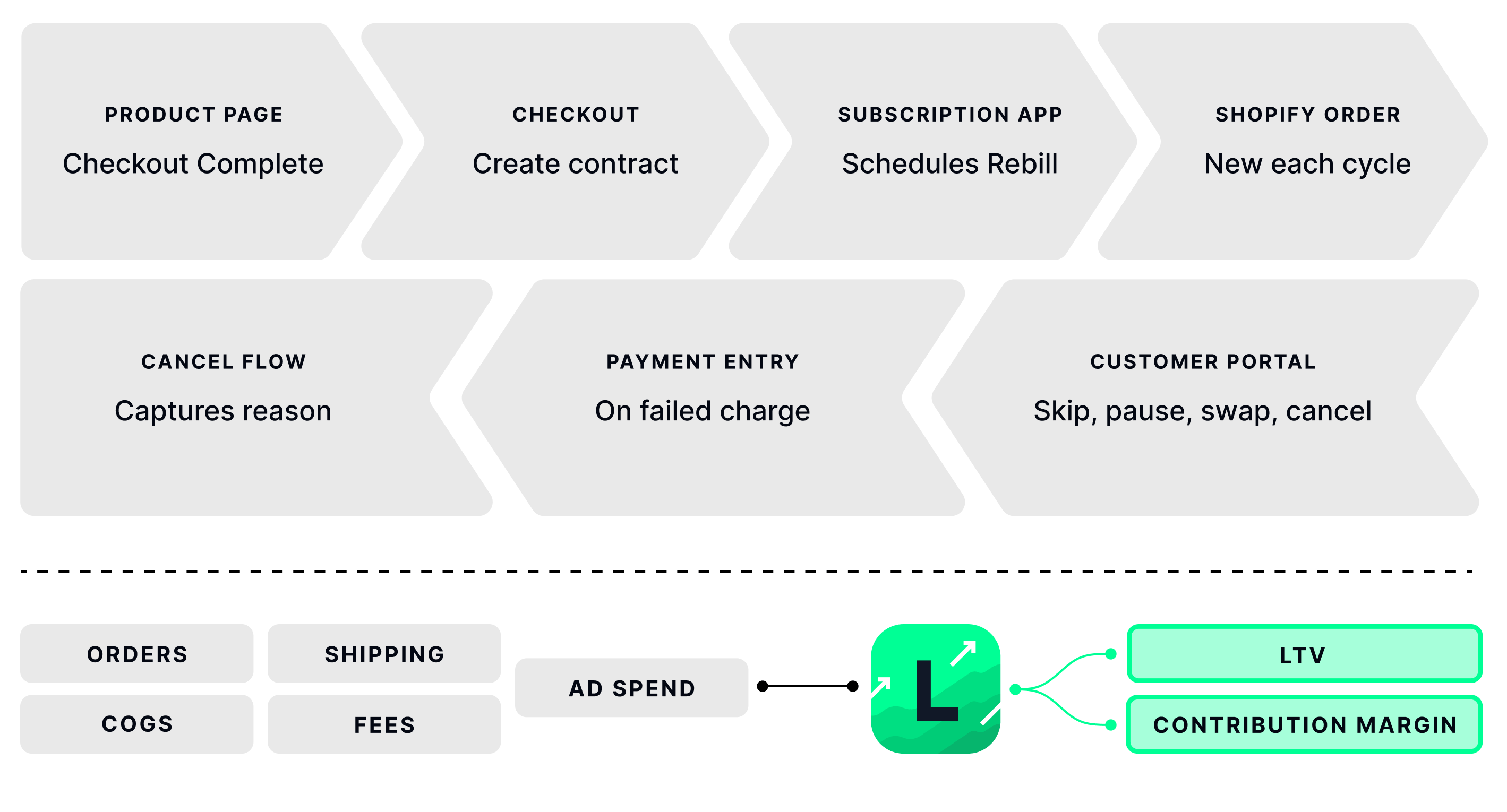
Every Shopify subscription app runs on the same underlying rails, which Shopify calls selling plans and subscription contracts. The details differ by app, but the flow is the same:
1. The selling plan. The app adds a purchase option to the product page: buy once, or subscribe and save with a delivery frequency and a discount. That option is a selling plan, and it carries the billing, delivery and pricing rules.
2. The contract. When a customer checks out with a selling plan, Shopify creates a subscription contract: the agreement between the customer and the store, with the products, price, frequency and saved payment method. Shopify notifies the app, and the app takes over management of that contract.
3. The rebill. On each scheduled date the app asks Shopify to attempt a charge against the saved payment method. If it succeeds, Shopify creates a brand-new order, exactly like a normal purchase. This matters more than it sounds: every rebill shows up in your Shopify orders, which is what makes it possible to measure subscription revenue alongside everything else the customer buys.
4. The portal. The customer manages the subscription themselves: skip the next delivery, change the date, swap a flavour, add a one-time item to the next box, update a card, pause or cancel. Portal quality is where apps compete hardest, because a confusing portal creates support tickets and cancellations in equal measure.
5. Payment recovery. When a card fails, the app retries on a schedule, emails or texts the customer to update the card and, in some apps, falls back to a backup payment method. This is called dunning, and it is the difference between losing a subscriber to an expired card and keeping one who never meant to leave.
6. The cancellation flow. When a subscriber clicks cancel, the app asks why and responds with a save offer matched to the reason:
- a pause for “I have too much product”
- a swap for “I want to try something else”
- a discount for “too expensive”
The reason is stored against the subscription.
7. Reporting. The app reports active subscribers, churn, monthly recurring revenue (MRR), skip rates and cancellation reasons. It knows everything about the subscription and, as we will get to, very little about the rest of the customer’s relationship with your store.
Why subscriptions matter more than the signup count suggests
The case for subscriptions is usually made in terms of predictable revenue, and that case is real. A store with 4,000 active subscribers on a 30-day cycle knows roughly what next month looks like before it starts, which makes inventory, cash flow and ad budgets far easier to plan.
The bigger case is what subscriptions do to customer lifetime value. Acquiring a customer through paid social is expensive and getting more so. A one-time buyer has to be persuaded again every time. Across $10.1B in DTC sales, only 14.7% of new customers buy again within 90 days. A subscription makes that second order the default instead of a persuasion job. A subscriber has agreed to keep buying until they say otherwise, so every extra cycle they stay is revenue you did not have to pay an ad platform for.
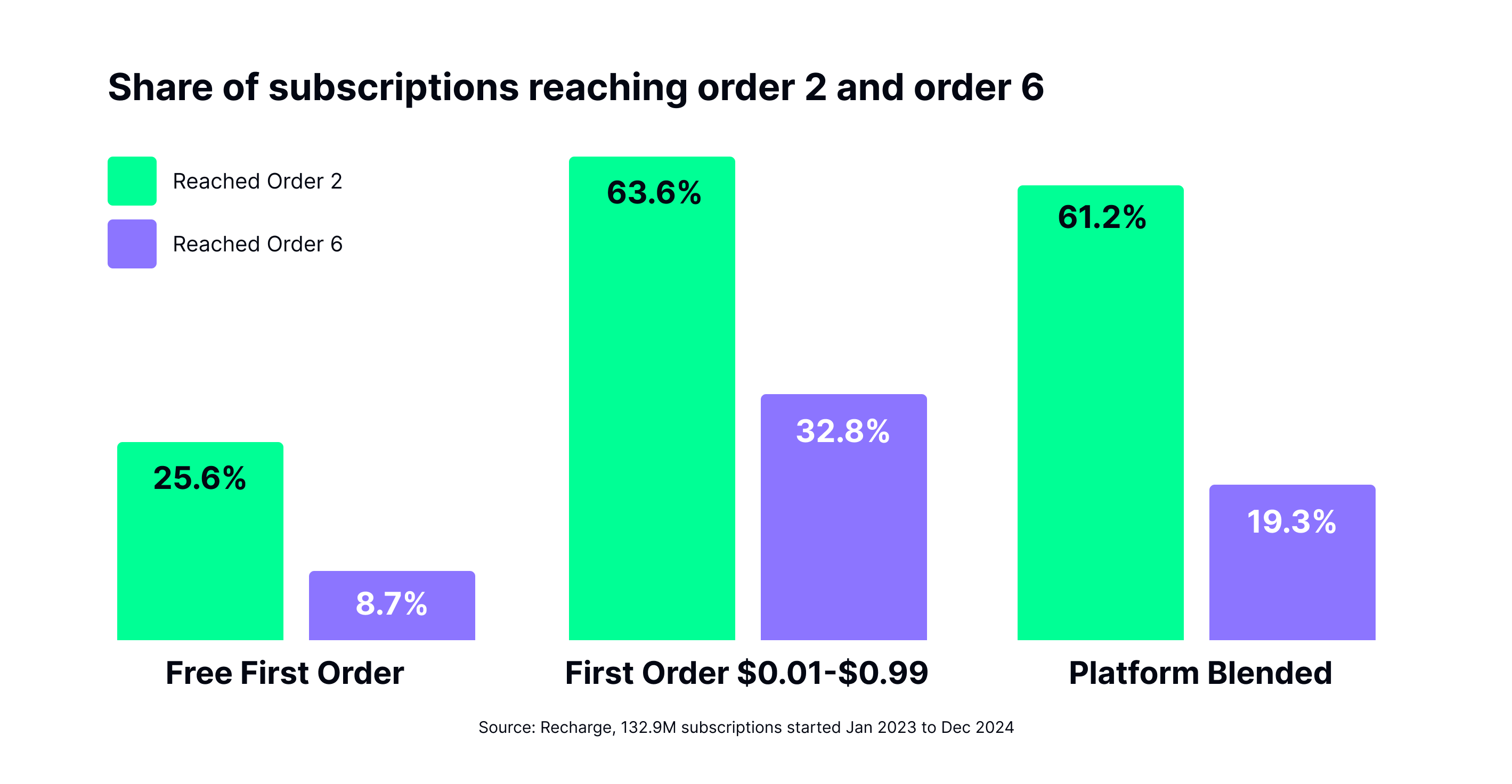
Which is why the number to watch is not how many people subscribe. It is how many are still there several cycles later. Recharge analysed 132.9 million subscriptions started on its platform between January 2023 and December 2024 and found that 61.2% reached a second order and 19.3% reached a sixth. The second order is the moment a signup becomes a subscriber. By the sixth, the intro offer is long gone and you are looking at real repeat behaviour.
The same analysis showed how much the intro offer shapes that curve. Subscriptions that started with a free first order reached a sixth order 8.7% of the time. Subscriptions whose first order was priced between one cent and 99 cents reached it 32.8% of the time, nearly four times as often. A token payment beat a free box by a wide margin, most likely because the act of paying, however small the amount, filtered for people who meant to buy.
Two lessons follow. Judge a subscription offer on who comes back, not on who signs up. And measure subscribers in cohorts, by the month they started and the cycle they reached, because an average across everyone hides the difference between the cohort you acquired with a deep discount and the one you acquired at full price.
The main Shopify subscription apps
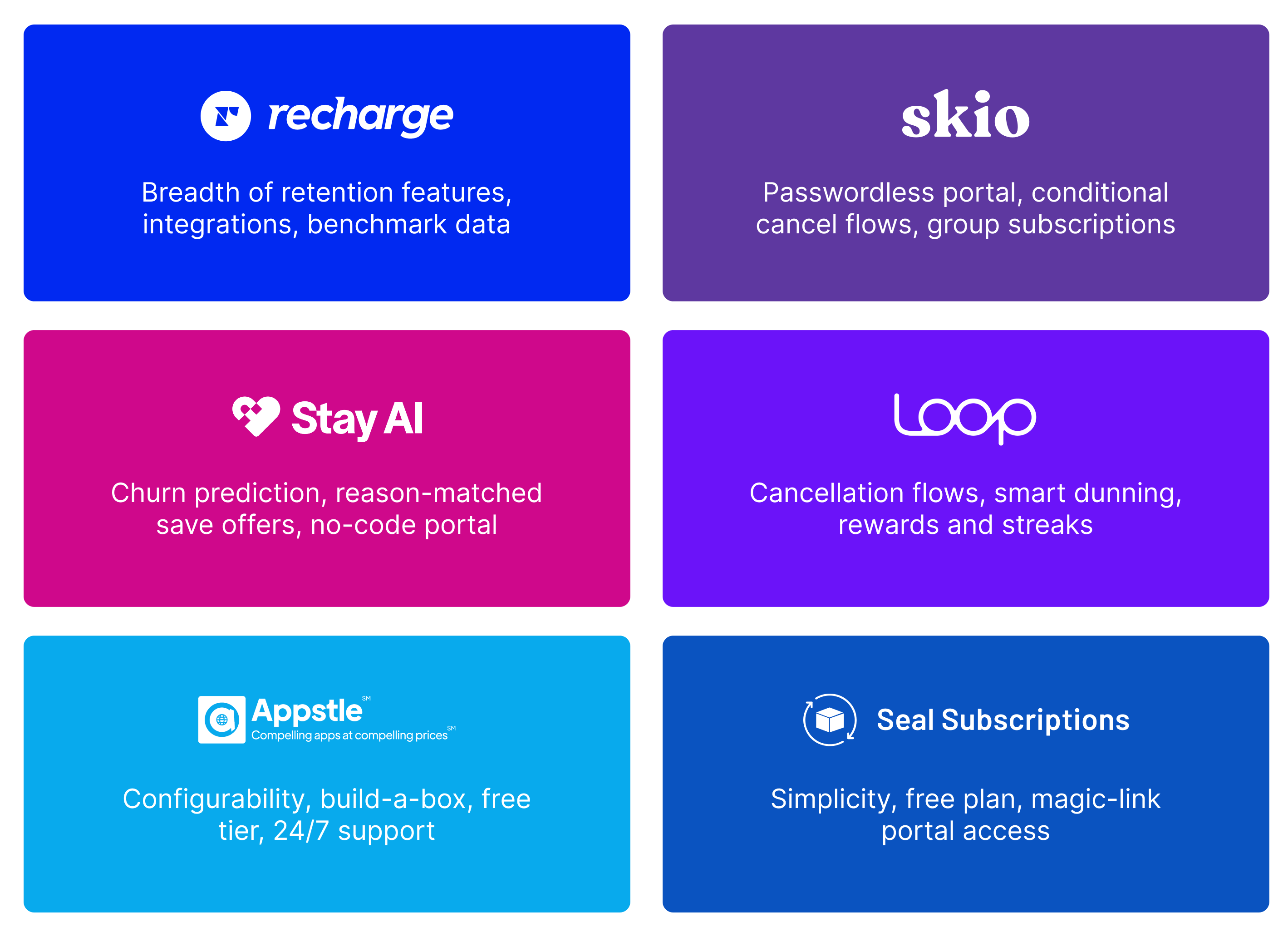
Most brands end up choosing between six apps: Recharge, Skio, Stay AI, Loop, Appstle and Seal. They all run on the same Shopify rails described above, so the differences are in retention tooling, portal design, pricing model and the size of brand they are built for.
Recharge. The longest-established and most widely used, with one of the broadest feature sets: customer portal, cancellation flows, bundles, upsells, loyalty and SMS, plus a large integration ecosystem. Used by brands of every size and a common choice for enterprise programmes. Recharge also publishes some of the most useful benchmark data on subscriber behaviour.
Skio. Built for fast-growing DTC brands and known for a friction-free customer experience: passwordless portal login with a one-time code, one-click checkout, conditional cancellation flows that respond to the reason given, build-a-bundle and group subscriptions. Skio positions itself as the app brands graduate to once subscriptions become a core channel.
Stay AI. A retention-first platform for brands already running subscriptions at scale. It predicts which subscribers are likely to cancel and serves save offers matched to the reason given, and it lets a retention team build journey-based promotions and a fully themed customer portal without developer time.
Loop Subscriptions. Covers the full subscription lifecycle with a strong emphasis on retention: cancellation flows with exit surveys, smart dunning with backup payment methods, and Loop Flows, which reward subscribers with streaks, milestone gifts and mystery rewards. Widely used by mid-market and fast-scaling brands.
Appstle Subscriptions. Highly configurable and priced for accessibility, with a free tier for stores below a modest subscription revenue threshold. Strong on build-a-box, loyalty perks for subscribers, tiered discounts and round-the-clock support. A common choice for brands launching a first programme or running large catalogues.
Seal Subscriptions. Simple, affordable and popular with smaller merchants. A free plan covers regular and prepaid plans, magic-link access to the customer portal and automated product swaps, with paid tiers adding cancellation flows and more advanced retention tools as the programme grows.
| App | Built for | Known for |
|---|---|---|
| Recharge | Brands of every size, including enterprise | Breadth of retention features, integrations, benchmark data |
| Skio | Fast-growing DTC brands | Passwordless portal, conditional cancel flows, group subscriptions |
| Stay AI | Brands running subscriptions at scale | Churn prediction, reason-matched save offers, no-code portal |
| Loop | Mid-market and fast-scaling brands | Cancellation flows, smart dunning, rewards and streaks |
| Appstle | First programmes and large catalogues | Configurability, build-a-box, free tier, 24/7 support |
| Seal | Smaller merchants | Simplicity, free plan, magic-link portal access |
All six connect to Lifetimely, so whichever one you run, the subscription data can be measured alongside the rest of the customer’s orders and costs. More on that below.
How to set up subscriptions on Shopify well
The steps that matter when setting up a subscription app:
1. Choose the app for the programme you will have in two years, not the one you have today. Migrating subscription contracts between apps is possible but painful. A brand launching its first subscribe-and-save on a couple of SKUs is well served by Appstle or Seal. A brand that expects subscriptions to become a major share of revenue should look at Recharge, Skio, Stay AI or Loop from the start.
2. Set the plan frequency around real usage. If a supplement lasts 30 days, a 30-day plan produces skips and a 35-day plan produces fewer. Offer two or three frequencies, and make the discount meaningful without being so deep that the programme cannot carry it cycle after cycle.
3. Be careful with the intro offer. A free first box fills the funnel with people who never intended to pay. Recharge’s data is the clearest evidence: a nominal charge on the first order nearly quadrupled the share of subscribers who reached a sixth order compared with a free one. The same trap shows up every Black Friday, where the offer that converts best on day one is often the worst by day 90.
4. Make the portal effortless. Passwordless or magic-link login, skip and reschedule in one tap, swap without cancelling. Every portal action a customer cannot find becomes a support ticket or a cancellation.
5. Turn on payment recovery from day one. Retries, card-update emails and, where the app supports it, a backup payment method. Churn from failed cards is the cheapest churn to fix, because nobody has to be persuaded of anything.
6. Build the cancellation flow around reasons, not discounts. Ask why, then match the response: pause for “too much product”, swap for “want something different”, a frequency change for “too often”. Keep the discount as the last resort.
7. Decide what you will measure before you launch. Cycle retention (the share of subscriptions reaching order two, three and six), churn split into voluntary and involuntary, skip rate and the value of a subscriber compared with a one-time buyer. Set the reporting up now, because subscriptions only reveal their economics months after they start.
Want to know what your subscribers are worth before you scale the programme?
Start a free Lifetimely trial and connect Skio, Recharge, Stay AI, Loop, Appstle or Seal in a couple of clicks.
Start free trial →Subscription metrics that matter, and what your subscription app cannot show you
Every subscription app reports a similar set of numbers, and they are the right place to start:
- Active subscribers and net subscriber growth (new minus churned) each month.
- Churn rate, split into voluntary (the customer cancelled) and involuntary (the card failed and was never recovered). Paused subscriptions are not churn. Count them separately.
- Cycle retention: the share of subscriptions that reach order two, three and six. This is a curve, not a single number, and it is best read by cohort.
- Skip rate, because a skip in the first 60 days is one of the strongest early signals of a cancellation to come.
- Average order value (AOV) per rebill, including one-time add-ons placed through the portal.
- Monthly recurring revenue, and how much of next month’s revenue is already booked.
- Cancellation reasons, read as a distribution over time rather than one at a time.
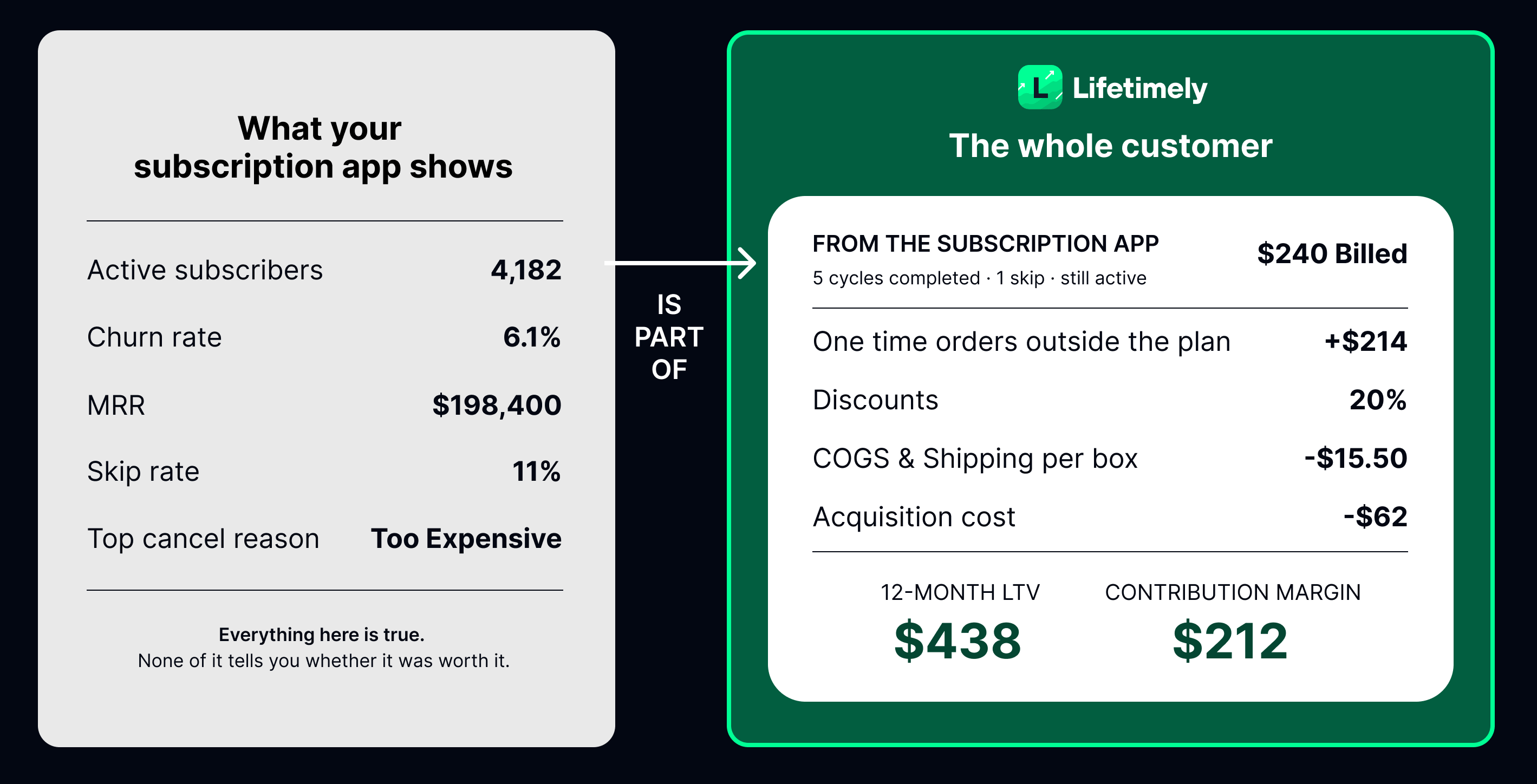
Then there is what the subscription app cannot tell you, because the data does not live there.
- What the subscriber cost to acquire. Ad spend sits in Meta, Google and TikTok, and the subscription app never sees it.
- What the products cost to make and ship. COGS, shipping costs and payment fees live in Shopify, your 3PL and your spreadsheets.
- What the discount cost. A 20% subscribe-and-save discount plus a 30% save offer plus free shipping is a very different margin from list price, cycle after cycle.
- What else the customer buys. Subscribers also place one-time orders. Some customers who never subscribed reorder as regularly as subscribers do. Neither shows up in the subscription app’s numbers.
- How subscribers compare with everyone else. Knowing a subscriber is worth $500 tells you little until you know a repeat buyer is worth $200 and a one-time buyer $60.
The two metrics that close the gap are lifetime value and contribution margin. Lifetime value (LTV) is the total a customer spends with you over a period, usually tracked at 6, 12 and 18 months from their first order, across subscription and one-time purchases together. Contribution margin is what is left of that spend after product costs, shipping, payment fees, refunds and the cost of acquiring the customer. A subscriber can be high on the first and low on the second, and that combination is exactly what a subscription app’s dashboard cannot show.
How to read subscription data without fooling yourself
Signups are not subscribers. Recharge’s platform-wide figures put second-order retention at 61.2%. On a free intro offer it was 25.6%. Report the second-order rate next to the signup count every time, or the funnel looks healthier than it is.
Averages hide the cohorts that matter. A blended churn rate mixes the January cohort acquired at full price with the March cohort acquired on a 50% first-box offer. Break retention down by start month, by acquisition channel, by first-order discount, and by what customers told you in a post-purchase survey, and the story usually changes.
Churn depends on the definition. Paused subscriptions, subscriptions under review after a failed payment, and expired prepaid plans are not the same thing as a cancellation. Decide what counts, write it down, and use the same definition every month.
Revenue per subscriber is not margin per subscriber. Each rebill carries a discount, a shipping cost and a payment fee. A subscriber on a deep discount with free shipping on a heavy product can generate a lot of revenue and very little contribution margin.
A saved subscriber is not automatically a win. If the save offer was 50% off the next three deliveries, you may have kept someone who now costs you money on every box. Save offers need to be judged on what they protect after the discount, not on how many people accepted them.
The subscription app only sees subscribers. The customers most worth converting to a subscription — the ones who have never subscribed but reorder the same product every five weeks like clockwork — do not exist in the subscription app at all. They are in your orders, and an RFM analysis is the quickest way to surface them.
What subscribers are worth: connecting your subscription app to LTV and contribution margin
Everything above is about running the subscription programme. This section is about valuing it.
Your subscription app knows who is subscribed, to what, on which plan, how many cycles they have completed, whether they skipped, why they cancelled and when the next charge is due. Shopify knows every order those customers placed, subscription or not, and what they paid. Add product costs, shipping, payment fees, refunds and ad spend, and you can put a value on any group of subscribers you can describe.
This is what Lifetimely does when you connect Skio, Recharge, Stay AI, Loop, Appstle or Seal. Every subscription, cycle and cancellation reason is matched to the customer behind it and to their full order history, then valued on LTV and contribution margin over 6, 12 and 18 months. From there, questions your subscription app cannot answer become ordinary reporting questions:
- Are subscribers worth more than repeat buyers once costs are in, and by how much?
- What share of subscribers acquired through Meta reach a sixth order, compared with those who came from email or organic search?
- Which cancellation reason costs the most in lost LTV, and which one is barely worth a save offer?
- Do subscribers who skip in their first 60 days go on to churn, and how early does that signal appear?
- Did last quarter’s save offer protect contribution margin, or did it keep subscribers who are now below your margin floor?
- Are one-time add-ons in the portal lifting margin, or just AOV?
- Which customers already reorder like subscribers without ever having subscribed?
- Which product or plan frequency produces the subscribers who stay longest?
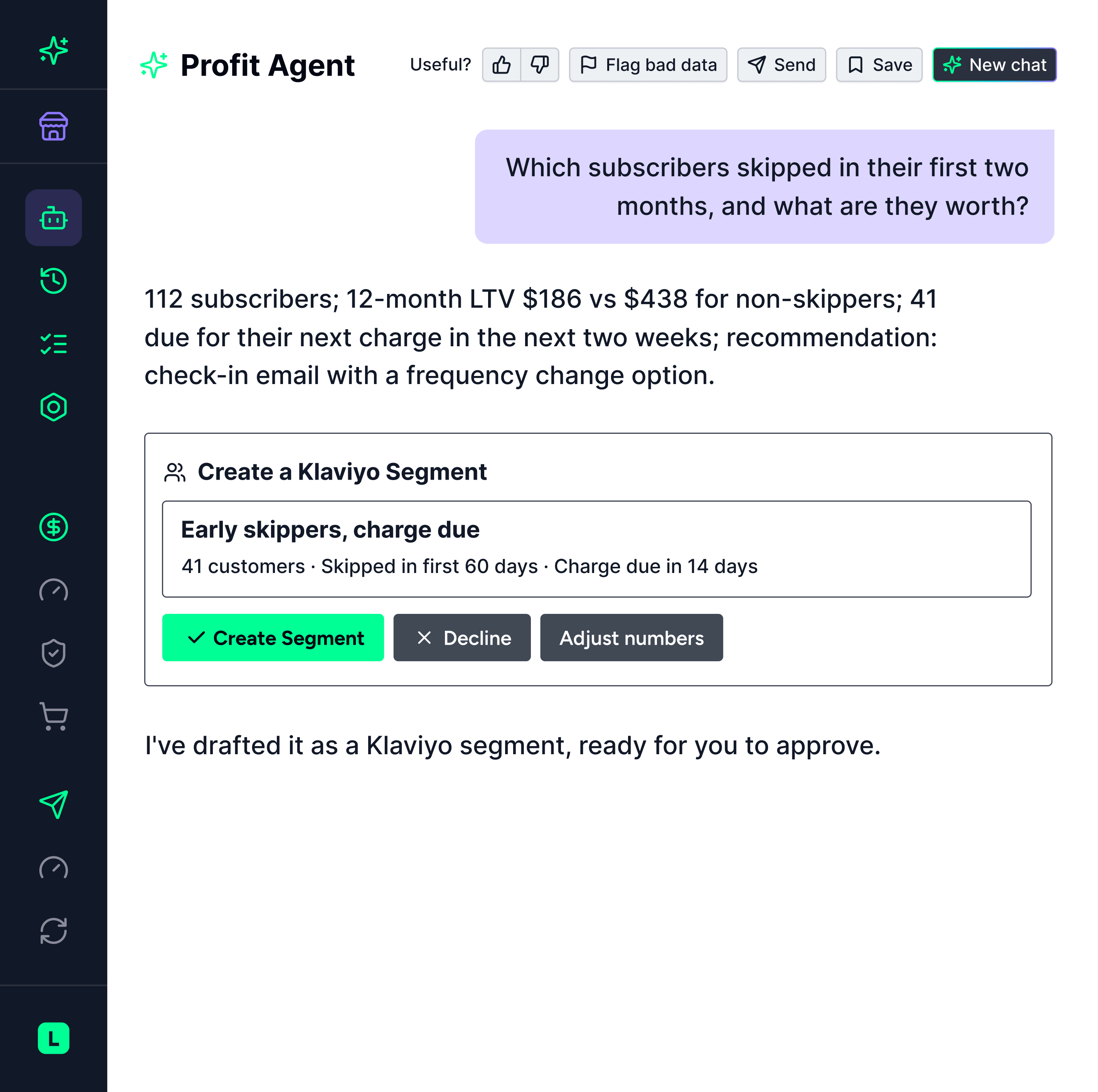
The Profit Agent makes this conversational. Instead of exporting from the subscription app and rebuilding it in a spreadsheet, you describe the group you care about in plain language: “subscribers who skipped in their first two months”. The agent works out how many customers match, values them on LTV and contribution margin against the rest of your base, and comes back with something like:
“112 subscribers skipped a delivery within 60 days of starting. Subscribers who skip that early have churned at about three times the rate of those who don’t, and their 12-month LTV lands at $186 against $438 for subscribers who never skip. 41 of them are due for their next charge in the next two weeks. For this group, a check-in email with a frequency change option has retained more LTV than a discount. Want me to build the Klaviyo segment?”
Say yes and the segment is created in Klaviyo and kept current as new subscribers match. The results come back to you, so you can see whether the flow paid off. You approve each step. Nothing is sent, built or changed without you. That is the difference between a dashboard and an agent, and why dashboards alone won’t make you money.
Some of the patterns brands find once subscription data has a value attached:
Subscribers are worth more, but not by as much as revenue suggests. A supplements brand sees subscribers at $412 in 12-month LTV against $179 for repeat buyers, a 2.3x gap. On contribution margin, after the subscribe-and-save discount and free shipping on every box, the gap narrows to about 1.6x. Still clearly worth it, but it changes how deep the intro offer can go.
The cancellation reason that costs the most is not the most common one. “Too much product” tops the reasons list, but those subscribers were happy with the product and often come back. “Didn’t see results” is a smaller group with far lower LTV who almost never come back, which points the fix at onboarding and product education rather than at the cancellation flow.
Early skippers are the easiest voluntary churn to prevent. Subscribers who skip in their first 60 days churn at roughly three times the rate of those who don’t. Catching them at the skip, with a frequency change rather than a discount, protects LTV that would otherwise be gone before the third rebill.
The best subscription candidates are not subscribers yet. Across the store, 184 customers have reordered the same refill two or more times in 120 days without ever subscribing, and 75 of them are due to reorder within two weeks. On contribution margin, each of them already out-earns a third of the current subscriber base, and nobody has asked them.
The save offer that works is not the deepest one. For a cohort cancelling over price, a switch to a quarterly plan at full price protected more contribution margin over six months than 50% off the next delivery, because it kept the customer paying full price instead of teaching them that cancelling earns a discount.
Already running Skio, Recharge, Stay AI, Loop, Appstle or Seal?
Connect it to Lifetimely and ask the Profit Agent what your subscribers are worth.
Start free trial →Shopify subscription apps FAQ
What is a Shopify subscription app?
A Shopify subscription app adds recurring purchase options to a Shopify store. It creates the subscribe-and-save option on the product page, charges the customer’s saved payment method on a schedule, creates a new Shopify order for each rebill, and gives the customer a portal to skip, pause, swap or cancel. Recharge, Skio, Stay AI, Loop, Appstle and Seal are the most widely used. Shopify also offers a basic native app called Shopify Subscriptions.
How do subscription apps integrate with Shopify?
Through Shopify’s selling plan and subscription contract APIs. The app defines selling plans on products. When a customer checks out with one, Shopify creates a subscription contract and hands it to the app, which then schedules and triggers each rebill. Because every rebill becomes a standard Shopify order, subscription revenue appears in Shopify alongside one-time orders and can be reported on with the same tools.
What is the best subscription app for Shopify?
It depends on the size and shape of the programme. Appstle and Seal are popular with brands launching a first subscribe-and-save on a small catalogue, partly because both offer free tiers. Recharge, Skio, Stay AI and Loop are built for programmes where subscriptions are a major revenue line and retention tooling, portal experience and integrations matter more than price. All six connect to Lifetimely.
Does Shopify have its own subscription app?
Yes. Shopify Subscriptions is a free app from Shopify that covers selling plans, automatic rebills and a basic customer portal. It works well for simple programmes but does not offer the reason-matched cancellation flows, build-a-box, rewards or retention reporting that dedicated apps provide.
How do I set up a subscription service on Shopify?
Install a subscription app, create selling plans on the products you want to offer (frequency and discount), configure the customer portal, turn on failed payment recovery, build a cancellation flow that asks for a reason, and connect the app to your email platform and your analytics. Most brands are live within a day. Getting the offer and frequency right takes a few cohorts of data.
What is a good subscription churn rate?
It varies by category and cycle length, so start by comparing against your own cohorts and your category benchmarks. As a reference point, Recharge’s platform data shows about 61% of subscriptions reach a second order and about 19% reach a sixth across all brands and verticals. Split churn into voluntary and involuntary, and exclude paused subscriptions from the count.
How do I reduce subscription churn?
Match the plan frequency to real usage so subscribers skip less, recover failed payments automatically, build a cancellation flow that responds to the stated reason with a pause, swap or frequency change before offering a discount, and act on early signals such as a skip in the first 60 days. Then check which of those actions protected LTV and contribution margin, not just how many subscribers stayed.
How do I measure the lifetime value of a subscriber?
Track everything the customer spends from their first order onwards, subscription and one-time, over fixed windows such as 6, 12 and 18 months, then subtract product costs, shipping, fees, refunds and acquisition cost to get contribution margin. Compare subscribers with repeat buyers and one-time buyers acquired in the same period. Tools that connect your subscription app to your order and cost data, such as Lifetimely, do this without exports.
Run the subscription, then value it
A Shopify subscription app turns a one-time buyer into a customer who keeps paying you back. Pick the app that fits where the programme is going, set the plan and the intro offer around retention rather than signups, fix the churn that needs no persuasion first, and read the numbers by cohort. Then do the part the subscription app cannot: find out which subscribers, plans and save offers are worth the most in LTV and contribution margin, and which are costing you.
Lifetimely connects to Skio, Recharge, Stay AI, Loop, Appstle and Seal, as well as Shopify and Klaviyo, and puts a value on your subscribers in LTV and contribution margin as soon as your data is in. Built on $100B+ in GMV across 45,000 Shopify stores, it already knows what a healthy subscription cohort looks like for a brand like yours.
Find out what your subscribers are worth.
Start free trial →Nuno Brito
Nuno Brito is Growth Lead at Lifetimely, where he writes about profit, retention and the numbers ecommerce brands should actually run on. He has spent over a decade in B2B SaaS marketing, from copywriting to product marketing and GTM at PandaDoc, Talkdesk and TaxCloud, including launching PandaDoc Notary to seven-figure ARR. He has a soft spot for SEO and AEO. When he's off the clock, he's looking for a wave to surf.