









Agentic AI Ecommerce: Why Dashboards Won't | Lifetimely
Written by
 Patrick Barnes Cofounder and CEO of AMP
 Dashboards don't make you money. Agents do.
Every DTC operator has the same problem: too many dashboards, not enough decisions.
Shopify in one tab. Lifetimely in another. GA somewhere else. Paid media reports arriving on someone else’s schedule. A retention tool showing one view of the business, a finance sheet showing another, and a team trying to stitch it all together fast enough to act.
The issue is not lack of data. It’s lack of follow-through.
Most tools tell you what happened. Few tell you why. Almost none tell you what to do next. And none carry the work forward for you.
That’s the gap we built the Profit Agent to fill.
The Profit Agent is the first agentic AI built specifically to run your store’s performance cycle with you:
- watching what changes
- identifying what matters
- proposing what to do next
- helping you close the loop after action is taken
Get started for free
See what the Profit Agent finds in your store in the first 24 hours. No setup call required.
Start free →What “agentic AI for ecommerce” actually means
The term gets thrown around loosely, so it’s worth being precise.
Generative AI answers a question when you ask one. You prompt it. It responds. That can be useful, but the cycle still depends on you to notice the issue, frame the question, gather the data, and decide what to do with the answer.
Agentic AI works differently.
It operates toward a goal. It observes what is happening, reasons about the change, decides what matters, uses tools to move the work forward, and keeps going until the cycle is complete. You stay in control, but you stop being the bottleneck for every step.
That matters in ecommerce because running a store is not a one-time analysis task. It is a constant loop:
- Monitor performance.
- Diagnose what changed.
- Plan a response.
- Execute with approval.
- Measure the result.
- Repeat.
Today, that loop usually runs at the speed of your available time. The Profit Agent is designed to run it at the speed of the business.
The side of agentic commerce we’re building for
A lot of the agentic AI conversation in commerce is focused on the shopper side: assistants that browse, compare, recommend, and eventually buy on behalf of consumers.
That world is real. But it’s not the problem we set out to solve.
We’re building for the operator behind the storefront.
The merchant making calls on pricing, retention, acquisition, product mix, inventory, and margin. The person trying to grow the business without letting profit leak through the cracks. The team that does not need another dashboard, but does need a system that helps them act with confidence and speed.
That is where the Profit Agent lives.
What the Profit Agent does
The Profit Agent runs the full performance cycle of your store.
It monitors continuously
Not a dashboard you have to remember to check. Not a report you open after the fact. The Profit Agent watches the business continuously and flags what actually needs attention.
It diagnoses what changed
When something moves, it does not stop at the headline.
It explains the change with context: product mix, customer cohorts, repeat behavior, contribution patterns, and the commercial details behind the number.
A dashboard might tell you revenue moved. The Profit Agent tells you what moved underneath it.
It plans the response
Not “AOV is down.” Not “repeat rate changed.” A real next step, grounded in the structure of the business and informed by what has worked in similar stores.
It executes on your approval
You stay in control. The Profit Agent works within guardrails you define and executes only when you approve.
Get started for free
See what the Profit Agent finds in your store in the first 24 hours. No setup call required.
Start free →It reports back
It does not disappear after the recommendation. It comes back with results so the cycle keeps running and the business keeps learning.
What this looks like in practice
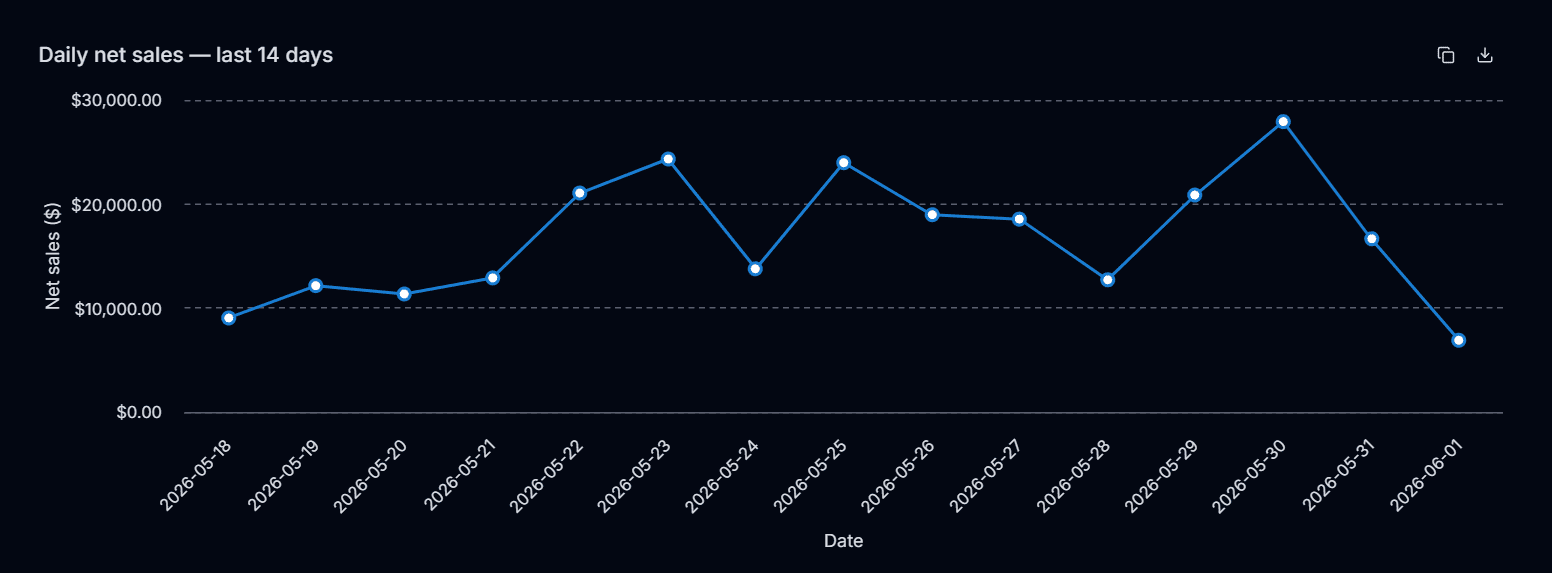
In one store, the Profit Agent surfaced $504.6K in net sales across 4,615 orders in the last 30 days, up 15.1% versus the previous 30-day period, while AOV held essentially flat at $109.35.
A dashboard can show that revenue went up. But that alone does not tell you what changed.
What matters is what the agent can infer from the pattern: growth happened without a meaningful lift in basket size. In other words, the gain came from more orders, not larger ones.
The difference between seeing and understanding
This is where most analytics workflows break down.
A dashboard is good at surfacing a number. It is much worse at carrying the work forward.
- Revenue is up.
- AOV is flat.
- A top SKU is selling.
- Repeat rate moved.
Fine. Now what?
That is the real workload inside a store: determining whether a change matters, what caused it, what action is worth taking, and whether the action actually worked.
The Profit Agent closes that gap.
It does not stop at “here is the number.” It keeps going until the merchant has a recommendation, an approval path, and a way to measure the outcome.
The patterns hiding under the surface
The same store showed clear follow-on demand between product categories.
| First order category | Follow-on purchase | Customers | Rate |
|---|---|---|---|
| Sweatshirts (60,142 customers) | Joggers | 17,178 | 28.6% |
| Tanks (47,665 customers) | Sweatshirts | 13,294 | 27.9% |
| Joggers (74,118 customers) | Sweatshirts | 18,776 | 25.3% |
That is not just a retention stat. It is a concrete view of how customer demand progresses through the catalog.
That matters because most teams are still making merchandising and lifecycle decisions from top-line rankings alone. They know what sold. They do not know what customers tend to buy next.

Product rankings are only the starting point
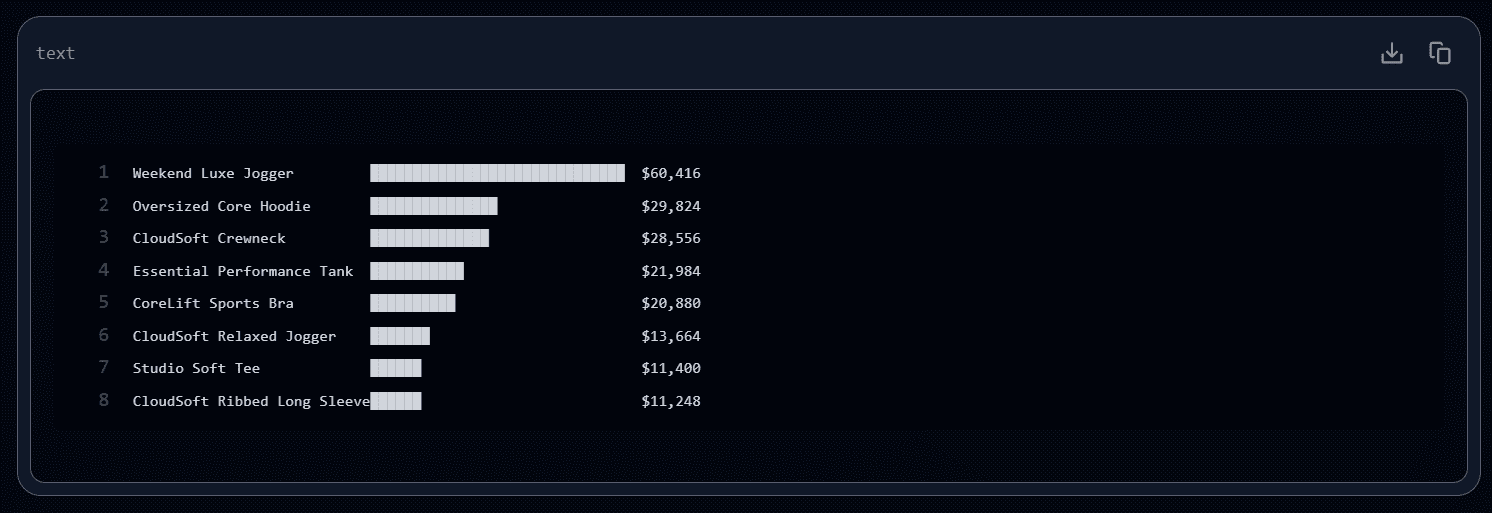
In the product revenue ranking we pulled, Weekend Luxe Jogger led at $60.4K, followed by Oversized Core Hoodie at $29.8K and CloudSoft Crewneck at $28.6K.
| Product | Product type | Revenue | Orders | Customers |
|---|---|---|---|---|
| Weekend Luxe Jogger | Joggers | $60,416 | 512 | 512 |
| Oversized Core Hoodie | Sweatshirts | $29,824 | 233 | 233 |
| CloudSoft Crewneck | Sweatshirts | $28,556 | 242 | 242 |
| Essential Performance Tank | Tanks | $21,984 | 376 | 376 |
| CoreLift Sports Bra | Sports Bras | $20,880 | 350 | 350 |
| CloudSoft Relaxed Jogger | Joggers | $13,664 | 112 | 112 |
| Studio Soft Tee | T-Shirts | $11,400 | 183 | 183 |
| CloudSoft Ribbed Long Sleeve | Long Sleeves | $11,248 | 150 | 150 |
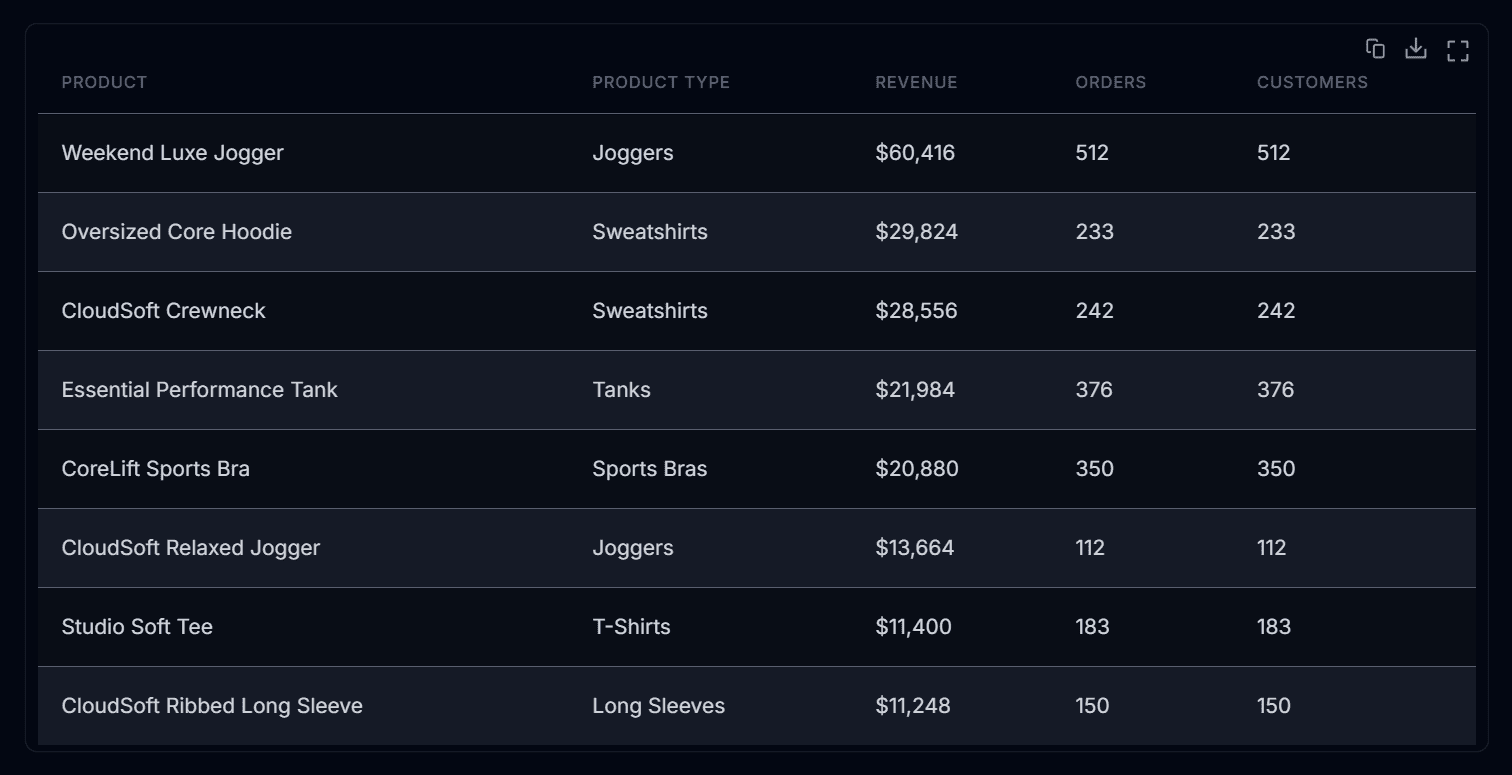
A standard analytics workflow stops here. It gives you a ranking and leaves the interpretation to you.
The Profit Agent treats a ranking as the start of the work, not the end of it.
A top-product table matters only when it connects to the next decision: whether those products are bringing in new customers, driving follow-on demand, protecting margin, or masking shifts elsewhere in the business.
Why this works: the Commerce Graph
Most AI tools in ecommerce are thin wrappers.
You export data. A language model interprets it. It gives you an answer that sounds polished, but you have very little reason to trust the judgment behind it.
We built something different.
The Profit Agent is grounded in Lifetimely’s Commerce Graph: $100B+ in GMV across 45,000 Shopify stores.
That foundation matters.
It means the system is not reacting to your store in isolation. It has context for what good looks like by model, growth stage, and operating shape. It can evaluate patterns against a much wider commercial base than any one merchant can build alone.
When the Profit Agent surfaces a finding, it is not just summarizing a spreadsheet. It is applying store-specific judgment to actual customer behavior, product movement, repeat patterns, and profit structure.
That is the difference between an AI tool that sounds smart and one that becomes useful enough to trust.
Get started for free
See what the Profit Agent finds in your store in the first 24 hours. No setup call required.
Start free →What you don’t have to do anymore
If your current workflow looks something like this:
- Shopify or Lifetimely for reporting
- ChatGPT or Claude for ad hoc analysis
- A few standalone apps for upsells, retention, or testing
- A Slack thread full of half-finished decisions
The Profit Agent absorbs the operational drag between those systems:
- No more export-paste-prompt loops just to ask a basic business question.
- No more waiting for a monthly report to explain what changed three weeks ago.
- No more static configuration in an app without any feedback on whether the setup is helping.
- No more checking dashboards only when you remember.
Instead of carrying every step yourself, you review the moments that matter and approve the actions worth taking.
The part we won’t compromise on: you stay in control
There is a lot of loose language in AI right now around autonomy. That is not how we think about trust.
The Profit Agent does not execute because it can. It executes because you approved it:
- You define the guardrails.
- You decide what it can touch.
- You set the escalation points.
- You choose how far it can go.
That is deliberate.
Trust is earned through repeated, useful, reviewable actions. We would rather build that trust one approved action at a time than ask merchants to hand over the keys on day one.
Why dashboards are not enough anymore
Dashboards still have value. They are good at showing a number.
They are much worse at carrying the work forward.
A dashboard can tell you:
- revenue is up
- AOV is down
- repeat rate moved
- a product sold more this week
But the operator still has to answer the hard questions:
- Is this noise or a real shift?
- What changed underneath the number?
- Which customers or products explain it?
- Does this require action now?
- What action is actually worth taking?
- Did the action work?
That is the gap between visibility and execution. And that is where the Profit Agent lives.
What’s coming next
This launch is the foundation, not the finish line. What comes next is deeper specialization across the operating surfaces that matter most:
- retention
- acquisition
- merchandising
- pricing
- profitability
All inside the same cycle.
We also expect commerce to move toward agent-to-agent workflows, where structured performance, product, and policy data can move between platforms, partners, and systems more intelligently.
We are building for that future now.
The direction is simple: more of the loop handled, less of the operational weight on the merchant.
The work required to run a great store keeps increasing. The number of hours in the day does not. Agents should close that gap.
Where to start
If you run a DTC brand and you have ever closed a dashboard tab without acting on it because you did not have the time, confidence, or context to know what to do next, this is for you.
The Profit Agent watches your store, finds what matters, proposes what should happen next, and helps you follow through.
You approve what ships. You stay in control. The business moves faster.
Get started for free
Connect your store in two clicks. The Profit Agent gets to work immediately and surfaces its first findings within 24 hours.
Start free →Patrick Barnes
Patrick is the cofounder and CEO of AMP, the company behind Lifetimely and the Profit Agent. He has spent more than a decade building and leading commerce software businesses, including senior product roles at G2 after the acquisition of Advocately, the SaaS company he previously cofounded and ran as CEO. Earlier, he led sales at TradeGecko and later returned as an advisor through its acquisition by Intuit. His background spans product, sales, and operating leadership across DTC, B2B SaaS, and ecommerce infrastructure.